
Growing ginger, turmeric and galangal
Top tips
- use Australian produce only
- begin preparation in September
- leave the crop in the ground for 2 years
- cure your produce before storing
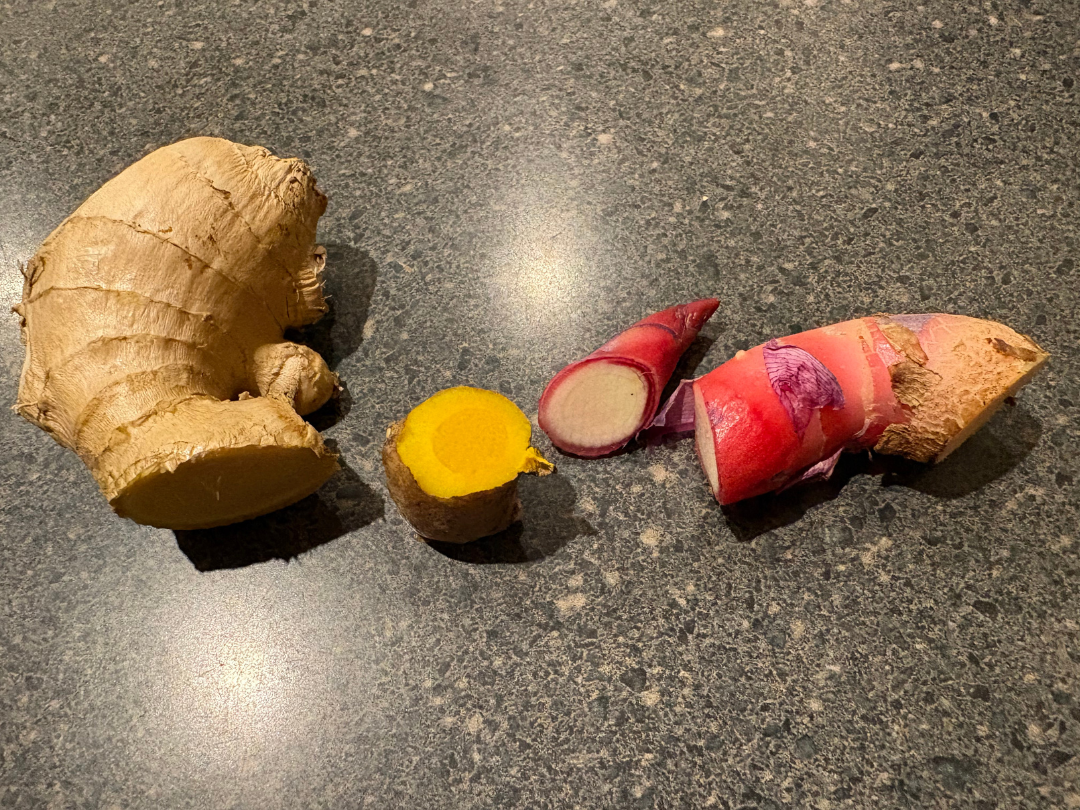
Ginger (zingiber officinale), turmeric (Curcuma longa) and galangal (Alpinia galanga) are all members of the ginger family, Zingiberaceae, and are perennial plants though often treated as annuals. They are tropical plants that love warmth, humidity, moisture and surprisingly, partial shade. Ginger especially does poorly in full sun while turmeric can better tolerate it but prefers partial shade as does galangal.
The first step in growing your own, is to obtain a supply of ginger, turmeric or galangal* preferably organic, and definitely Australian. Imported rhizomes will have been sprayed with a shoot inhibitor so will not reproduce.
Ideally, plant in October but begin preparation in September. In September, cut the rhizomes into pieces each with a ‘knob’ which will bud. Leave them in the sun for a day for the wound to dry and then place these in a dark, airy place such as a cupboard for a month until they begin to shoot. That’s the time to plant the pieces out.
Prepare the soil well. Dig it over so that you remove all clods and sticks and stones, and incorporate compost. The soil needs to be ‘loose’, fertile and very well drained as soggy soil will rot the rhizomes. Plant each piece at a depth of about 2 cms and water well. Water regularly to keep the rhizomes moist but not sodden. Ginger and galangal will grow horizontally, close to the surface, while turmeric will grow vertically with the rhizomes deeper down in the soil. If you are growing these in pots, the ginger and galangal rhizome will be at the top of the pot when harvested and the turmeric at the bottom.
Rhizomes will begin multiplying once the plant has flowered and needs 10 months to reach maturity. It can be harvested then but it is better to leave the crop in the ground for 2 years. Harvest when the leaves die down in August, and immediately set aside some rhizomes for dividing, preparing as above, and replanting in October. In the meantime, you can harvest small amounts by brushing back the soil and cutting pieces off.
To harvest, remove the soil around the withered stems by hand to assess how wide the clump is and then prise it out with a fork. Try to slide the fork beneath the clump and lift it to avoid piercing the rhizomes. Remove as much dirt as you can by hand and then hose the clump. You can break rhizomes into smaller pieces to clean them better. After that, comes curing which is really just the process of drying the skin and letting it harden. Leave the rhizomes outside on mulch in the sun for a couple of days and this will do the trick.
There are 2 ways to prepare the root. If you want dried ginger, turmeric and galangal, slice the rhizomes into thin rounds – no need to peel – and dry them for 4-5 hours in a dehydrator. Then it’s blending time. I use a Nutribullet to blend them to a fine powder as my food processor is not strong enough. Roughly, the fresh weight will reduce by 75% once dried. The second way is to store it fresh in a bucket of sand. The sand will keep it fresh and keep mould away indefinitely. Alternatively for short-term storage keep it in the fridge for about 2 weeks, in a paper bag, before it is past its best.
* turmeric and galangal can be bought as plants from the Sustainable Macleod Community Garden
Written by Robin Gale-Baker