
How to charge your EV
Here’s the scenario: you’ve just bought a new EV and you’re trying to understand how to charge it in the most efficient and cost-effective way.
Fundamentally it’s quite straightforward. An EV is an electrical appliance with wheels, so you plug it in as you would any other appliance and the battery fills up with charge.
Your new vehicle will most likely come with a cable, with a standard plug on one end designed to connect your car to any household electrical socket. Put the large plug on the other end of the cable into your car port and the battery will charge at around 10 amps – taking quite a few hours to fully charge the battery.
What about travelling?
Anywhere you can get access to a standard household socket, you can charge. These days many accommodation destinations such as Air BNBs and caravan parks will be happy for you to use their power. Some will charge, others will offer it free.
Some of these places will have a dedicated charger and you will need a Type 2 (Mennekes) cable, which will also allow you to connect to a wide range of public chargers which charge at around 22 kW using AC power. If you’re having a meal while charging, you can expect to add between 25%-50% charge to your battery. Banyule City Council has installed a number of these chargers to encourage EV uptake.
If your car doesn’t supply a Type 2 cable, you can buy one from one of the many suppliers. If your EV supplier has one to buy as an option, check that it doesn’t cost a fortune. You should pay no more than $200. If you buy an older model Nissan or Mitsubishi (almost certainly a refurbished model), which uses a CHAdeMO plug, you will need to get this type of cable.
Most public charging requires payment. There are several charging providers, with Chargefox and Evie being the main ones, aside from Tesla’s own charging stations. These charging providers require you to have a phone app and account, with a registered credit/debit card. You can request a backup RFID (Radio Frequency ID) physical card, in case you have problems with mobile reception. Starting to charge requires you to locate the specific charger on the location map on the app. Once you have plugged in, you use the app to start the charge. Press the release button on your car charging port, and the charging stops.
Increasingly, these companies are adding automatic charging, where you simply plug in and the charger recognises your EV and begins charging. Increasingly we will be able to tap with a standard credit/debit card without a dedicated account. This is quite common in places like the UK.
Faster charging
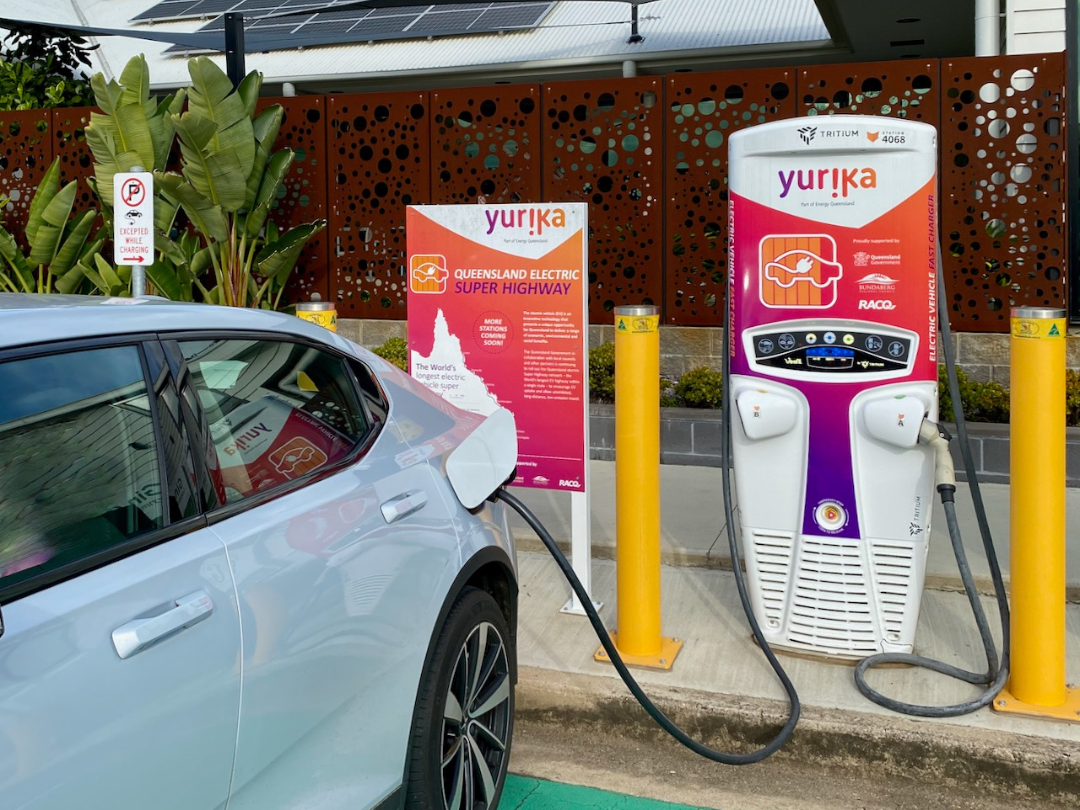
There are increasing numbers of much faster charging stations again with Chargefox and Evie being the most common. These DC chargers can offer very fast speeds, with 50 – 150 kW being usual. Chargers of up to 350 kW are starting to appear. The rate at which your car charges is also dependent on how it is designed, with newer models offering very rapid charging.
A final word on planning your charging away from home. Plugging in while you do your shopping or have a meal is a very effective way to charge your car. All the major shopping locations in Banyule have chargers. If you are going on a longer drive, it makes sense to have the PlugShare app – an excellent free user-maintained guide to every charging station (here and overseas), with comments on what to expect from a user’s point of view. Additionally, your car will almost certainly have a navigation system which will include locations of charging stations and accurately predict your level of charge at your destination. More sophisticated car systems will inform you if a charging station is in use.
The easiest charging
By far the easiest way to charge is to plug in at home, preferably with a professionally installed EV charger. The Type 2 cable is required for these and you will be charging at 22 kW or more. This will increase your charging speed compared to using the standard household socket by 3-10 times, depending on your house wiring. If your home has solar installed, with the right charger, you can set your EV to charge when there is excess solar – saving you money.
If you don’t have solar, you can check your electricity retailer’s time of day fees and choose the cheapest. Your EV should have an inbuilt timer for you to set to the preferred time. You can also make use of the Victorian government’s 3 free hours of electricity starting in October this year.
Tips
As much as possible, keep your battery charged between 40-90% – this will mean the battery will last longer.
If you can, choose slower charging – another way to preserve battery life.
On longer trips, charge to 80% unless you need the extra range. After 80%, charging stations are programmed to slow down charging, adding considerably to charging times.
Before you travel, get the apps and an account with any charging companies you are likely to need. You can check which ones you need on PlugShare.
You can safely leave your vehicle to charge either publicly or at home. The cable is automatically locked and cannot be removed without your key.
Written by Paul Gale-Baker