
Pruning apricot and cherry trees
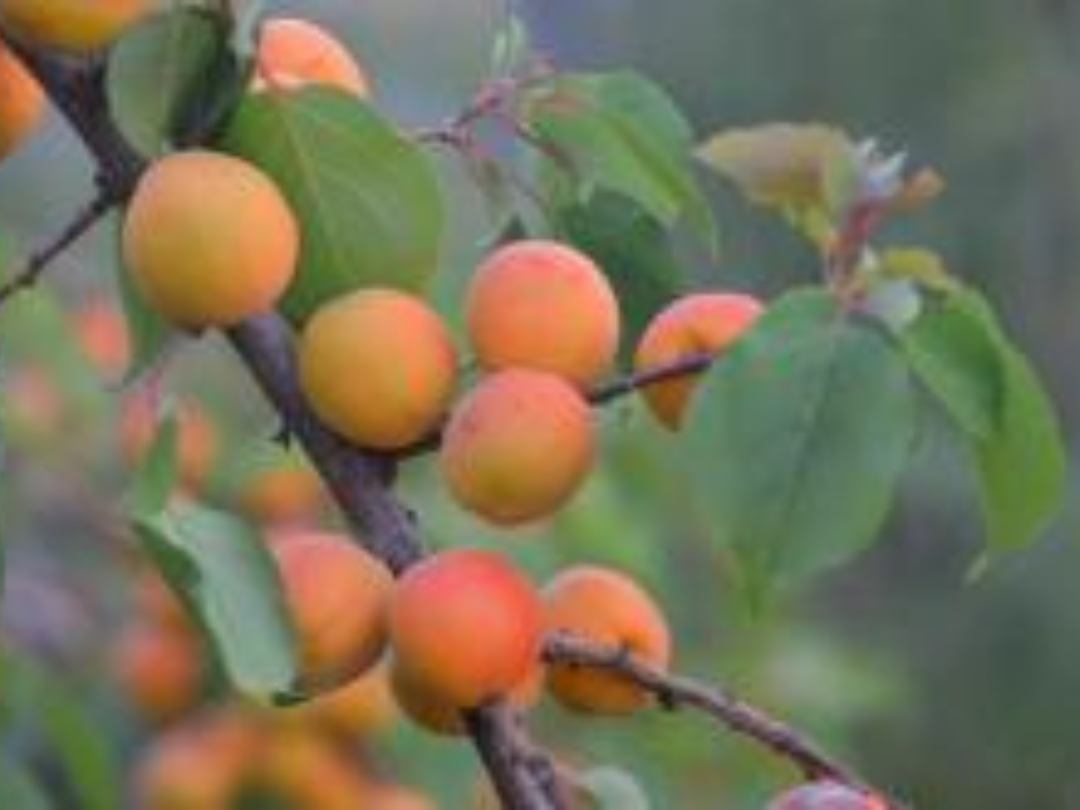
Top tips:
- Prune in February or March or not at all
- Prune only on a warm, dry day
- Use a thinning technique for pruning
- Keep watering after fruiting
Apricot pruning fundamentals
Prune the structural branches to a vase shape. Remove diseased, broken, and crossed branches and growth going toward the centre of the tree. Then, the important thing is not to prune off fruiting buds on one year old wood or spurs on older wood. Flower buds are produced on both. On one-year old wood there will be several flowers at the base of the branch and then possibly a single flower on the branch tip or close to it. On mature wood there will be knobbly spurs which bear for 2 -3 years only. Prune to an outer bud, using bench cuts (see below) to further shape the tree, keep it low and increase its productivity.
Cherry pruning fundamentals
Cherry trees are either sweet (eg Stella) or sour (eg Morello). Sweet cherries should be pruned in summer after harvest while sour cherries can be pruned then or in late winter when dormant which results in strong growth.
For both, prune the structural branches to a basket shape. Try to include 8 branches (which is twice as many as an apricot tree) especially for sour cherry varieties. Sweet cherries work as vase-shapes too. Make a careful selection at the nursery. Not all young cherry trees are equal! Although you will plant the tree in winter, its first prune should be in summer. Cherry branches grow straight up so bring the verticals down to the size you want and this will result in laterals developing at that tree height, and fruiting spurs developing on them and on wood below. Use bench cuts (see below) to achieve a low growing, productive tree.
Thinning vs Heading pruning
There are 2 commonly used methods of pruning fruit trees: heading and thinning.
Heading which is essentially cutting all branches at the same height leads to rapid, unregulated, vertical, tall growth with fewer fruiting flowers and buds (because this type of pruning removes all the terminal buds). Multiple shoots emerge below each cut, giving the tree a spiky appearance and the fruit grows high up making it difficult to harvest and net.
Thinning pruning combined with bench cuts on the other hand helps lower the tree height as cuts are made that result in horizontal branches. They also open up the centre of the tree for good air circulation, discourage overgrowth and encourage fruiting lower down, and as the trees are lower, are easier to net. Thinning cuts remove whole branches at the point of origin either on the trunk or on a lateral branch. Prune on the branch side of the collar I.e. not flush against the trunk or branch. The collar is the bulge that attaches to the end of a branch at the branch/trunk intersection.
Bench cuts
These cuts result in the development of horizontal branches. Fruiting happens on horizontal branches and not on vertical branches. The cuts are made just above the intersection of a thicker structural branch and a thinner lateral branch on the thicker branch. With the thicker branch above the cut removed, this then causes the tree to send its energy into the thinner, lateral branch, strengthening it and encouraging fruiting along it or in some cases tip fruiting as well.
Trees that have been headed can be renovated (renovation pruning) over several years by careful thinning and bench pruning cuts. This results in shoots developing on the lower trunk and these can be nurtured into horizontal limbs so that the tree changes shape and fruit is produced lower down. For more details and a sketch see the link below on ‘Pruning: thinning vs heading cuts’
Pruning equipment
Disinfect all pruning equipment including secateurs, loppers and saws before and after pruning and between cuts of diseased and healthy wood so that you don’t transfer infection between a diseased branch and a healthy one. Prune diseased branches back to healthy tissue. Always disinfect before you move on to the next tree. Use methylated spirits to disinfect equipment and a clean piece of rag each time you disinfect. Burn diseased limbs.
When to prune and why
Apricots and cherries (and also almond trees) should be pruned in February or March because of their susceptibility to bacterial canker when just pruned. Infection can be mitigated by pruning on a warm or hot, dry day (preferably with a breeze) in these months. This results in pruning wounds drying quickly.
No to wound sealant
Do not use wound sealants as these have been proven (since 1957) to be harmful. Trees need to form wood callouses on pruning wounds. Spraying or painting a wound prevents oxygen getting to it and results in poor callous development, which allows disease to enter the tree.
Gummosis aka bacterial canker
Gummosis is evident when amber-coloured sap oozes from bark, forming a seal on the branch. Commonly it affects apricots and cherries but also plums, peaches and nectarines. It has a number of causes and remedies:
Bacterial canker (Pseudomonas syringae) also known as gummosis is caused by bacterial pathogens that often enter the tree through pruning wounds when pruning has taken place in cool and/or wet conditions. The disease results in cankers forming on the wood – both on the trunk and branches. These are dark depressions which eventually ring the wood and cause dieback. Affected limbs must be removed but it is more difficult if the cankers are on the trunk and may result in the whole tree needing to be removed. Topically, the gum can be scrapped away, the area cleaned and Bordeaux mix applied. (Normally Sustainable Macleod recommends lime sulfur for treating fruit trees and not Bordeaux but in this case, Bordeaux is preferable)
- Damage caused by whipper-snippers, mowers or improper pruning including ragged cuts from blunt or unsuitable pruning equipment. Re-prune correctly where possible.
- Damage to bark and branches from possums or rats climbing the tree to eat the fruit. Net, weighing it down to the ground with something heavy; use rat bait for rats (see article on rat baits that do not affect owls and other wildlife under ‘References’ below). Prune off any damage
- Tree borers which will be evident from the frass (sawdust like substance) in the bubbles of gum or sitting in the V-crotches between branches or around the tiny holes in the tree. Prune off affected limbs
- Stress on trees caused by drought or water-logged soil. Increase watering or improve drainage as required
- Planting young trees too deeply. Make sure the graft is above ground
- Sunscald on the trunk of young trees causing injury to the tissue – paint on lime sulfur to protect the trunk from sunburn
- Young trees being bought from nurseries already infected by canker. Observe closely and prune off any affected limbs including any damaged during transport
Why water after fruiting?
Watering after fruiting is essential for good fruit production the following year. Bud development for the following year begins after fruiting so adequate watering enables the tree to take up nutrients. (Nutrients travel from the root zone via water to the flowers, buds and fruit). Insufficient watering means no or little nutrition for the tree. Water is stored in the tree roots and provides fuel for growth and fruit development in spring. Watering also reduces tree stress making it less likely that trees will succumb to pests and disease, be damaged by winds or cold, suffer moisture stress in hot weather or lack leaf activity (ie photosynthesis) which is essential for tree health.
Water until the hot weather is over, making sure adequate water is reaching the root zone. Dig down into the soil a little to check that the soil is moist. If it is, it’s unlikely to be hydrophobic deeper down. If it is hydrophobic, which is caused by the soil particles being covered by a waxy substance, put 2 drops of detergent in a 9 litre watering can of water, and water from the base of the tree to the drip line of the canopy, right round the tree, until the soil is moist. Detergent breaks down the surface tension of the waxy particles just like it breaks down grease when you are washing greasy dishes.
References
https://sustainablemacleod.org.au/pruning-thinning-vs-heading-cuts/
https://sustainablemacleod.org.au/how-to-deal-with-rats-while-protecting-owls-and-other-birds-of-prey/
https://sustainablemacleod.org.au/pruning-and-care-of-fruit-trees/
Written by Robin Gale-Baker