
Why bare-rooted fruit trees are worth it
Top tips
- Prepare your soil by removing competing grass
- Trim any broken roots
- Prune at planting time
- Plant within 24 hours
What is a bare-rooted fruit tree?
Bare-rooted fruit (and nut) trees are grown in the paddock and dug up when dormant. 90% of their roots are trimmed off, and they are placed in bags of damp sawdust and sent to the nurseries for us to purchase. Only deciduous trees go dormant and thus only deciduous fruit trees (e.g. apples, pears, apricots, cherries, plums, nectarines and peaches) can be obtained bare-rooted. Bare-rooted fruit trees are planted in winter.
Advantages
There are several advantages to planting bare-rooted trees. First, they are generally cheaper than potted trees. Second, planting them in winter allows them to establish while dormant and they will take off energetically in spring as long as they have been well-pruned at time of planting. Preferably plant your tree within 24 hours of purchase. Soak it in water and Seasol (seaweed solution contains trace elements) for 2-3 hours but not longer than 24 hours.
Site preparation
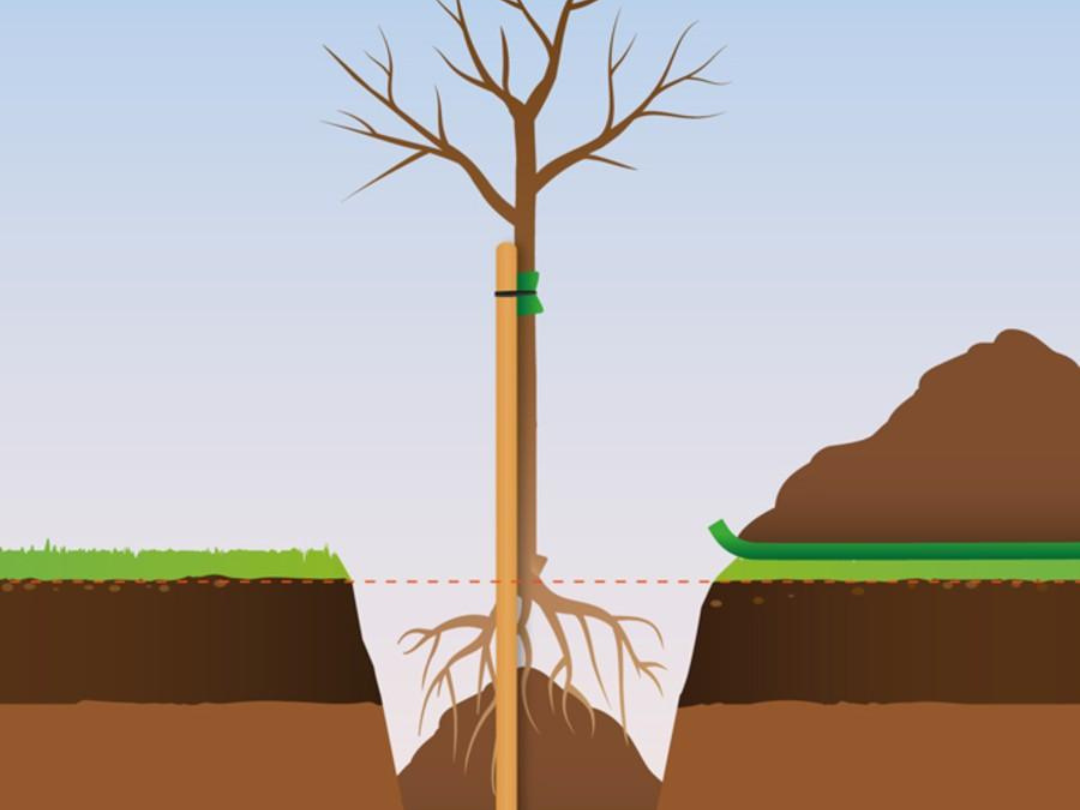
When planting, first survey the site. If it’s covered with weeds or lawn, remove about a square metre by cutting the turf into manageable sections and lifting it at various points with a fork (not a spade), loosening it until the roots give way and each section comes free. This prevents competition for the tree you are about to plant. Next, dig a hole as deep as the roots but twice as wide. If you are on clay soil add some gypsum, and add compost to all soils. If there are any broken roots, cut these off with sharp secateurs to prevent suckering. If you think it necessary to stake the tree, bang the stake in before placing the tree in the hole. This prevents the stake being driven through the tree roots. And remember to use soft-tie to tie the tree to its stake in a figure of 8, about 2/3 way up the trunk. Make sure the graft is above ground and all the roots are planted below the soil. Firm the soil but don’t compact it. Backfill, water and mulch.
Pruning at planting time
To balance the 90% of root removal, prune off 90% of the whippy branches. Your tree will come unpruned and if it is a vase shape you are after, cut out the central leader – that’s the vertical, centre branch. Select 3 or 4 side branches and prune these by about two-thirds, to an outward growing bud. The tree will look brutalised but this is necessary. In spring, you will reap the reward as the remaining buds burst into flower and the tree takes off.
Many nurseries sell bare-rooted fruit trees. They can also be ordered online but seeing what you are buying allows you to choose healthy trees with unbroken roots and a good shape, and allows you to purchase close to the time of planting. Nothing is worse than a tree coming early or late when you do not have the time to plant it!
Your tree’s first year
Water several times a week deeply throughout the hot weather. The first year your tree blossoms, it’s wise to remove the blooms so that all the tree’s energy goes into establishing a good root system which will pay dividends in the future.
Written by Robin Gale-Baker