Why “many planted for every one removed” doesn’t add up
The removal of 300 trees as part of the Macleod rail level crossing removal has left many residents shocked, not only by the scale of the clearing itself, but because the number of trees to be removed wasn’t declared until very late in the process. Very few of us understood just how extensive it would be before the work began.
Some questioned if the amount of vegetation removed was really necessary or whether it just made the construction cheaper and quicker.
Infrastructure is essential, and our transport networks need to evolve. I’m as much for the railcrossing removal as the next local who has sat in banked up traffic along Chapman and Carwarp Street. But as taxpayers, we deserve good planning that protects the natural assets that make our suburbs liveable. Where mature trees can be saved through different designs or construction methods, those options deserve serious consideration. Communities deserve transparent information, genuine consultation, and honest accounting of what will be lost before decisions are made.
We all want good bike paths and improved public transport. But many of us want to have a meaningful say about how it is done. It’s not unreasonable to expect our governments to provide that opportunity, rather than ticking the box with consultations only about the elements they are willing to take input on, such as the colour scheme of the bridge.
With the North East Link project also dramatically reshaping nearby landscapes, many of us are asking, why does progress always seem to come at the expense of trees? Why can’t we have a balance?
When large numbers of trees – including the critically endangered Studley Park Gum – were removed for the North East Link, we were told they would be replaced with two new (small sapling) trees for every one that was cut down. On paper, that sounds generous. In reality, it is a poor measure of what has actually been lost, and if I was pessimistic I would say it was a great piece of spin. Adding further insult, most were planted in Westerfolds Park in Templestowe and Montpelier Reserve in Lower Plenty – a long way from Yallambie where they were removed. Certainly far too far away for the wildlife that lived in them to relocate, and for residents to enjoy. Perhaps they were used as a convenient opportunity to revegetate areas (paddocks) that were intended at some stage to be revegetated anyway.
The problem with these policies is that they count the number of tree stems, not the value of the tree itself.
A mature tree is the result of decades, and sometimes more than 100 years, of growth. It provides cooling shade, stores large amounts of carbon, filters air pollution, absorbs stormwater (reducing erosion) and supports entire ecosystems including providing homes for wildlife.
Some of the trees removed from Rosanna Parklands contained hollows that had taken many decades to develop. Local native tree species such as eucalypts take 80 to 150 years before natural hollows begin to form. Hollows are fundamental to healthy native ecosystems as they provide (now rare) shelter for wildlife. Once those trees were felled and removed or chipped, the habitat was gone. While we are fortunate to have many remaining large trees in Rosanna Parklands, large habitat trees – native or otherwise – are sparse outside of the park and newly planted saplings will not replace what was lost anytime soon.
The loss has been deeply felt by many residents. We have lost the green screen that once softened views of the railway, reduced noise and helped cool the surrounding area. It was the leafy feel, with close proximity to natural bushland but with good transport links and bike paths that encouraged me to choose to live in Macleod.
Mature trees create comfort, privacy and beauty that small saplings simply cannot provide for many decades. The difference becomes even starker when we think about canopy. A mature tree may spread its branches over dozens or in some cases hundreds of square metres, providing cooling shade. Young saplings provide no canopy at all. Even if every replacement tree planted survives, it could take 30, 40 or even 50 years before they begin to provide similar shade, and much longer before they offer the habitat values of the large trees that were removed.
This matters now more than ever. We know the climate is becoming more extreme. Victoria is heading into a predicted hotter, drier spring, with El Niño increasing the likelihood of above average temperatures across much of southeastern Australia. At a time when our communities and wildlife need every bit of natural cooling available, we have removed hundreds of our most effective living air conditioners.
No one is suggesting that new trees and vegetation should not be planted. Our community will benefit from many more of them, and the (exceptionally vague mention of) 25,000 plantings in the ‘general area’ is welcome. But new plantings should be added to our urban forest, not be used to justify the removal of mature trees by claiming that saplings are an equivalent or improved replacement.
Rosanna Parklands is more than open space on a map. It is a place where people have made memories, where wildlife has found refuge, and where vegetation has quietly served the community for generations. When a tree is removed, we do not simply lose a trunk and a few branches. We lose shade, habitat, cooling, beauty, history and a living part of our neighbourhood.
That is why many newly planted saplings cannot equal one mature tree.
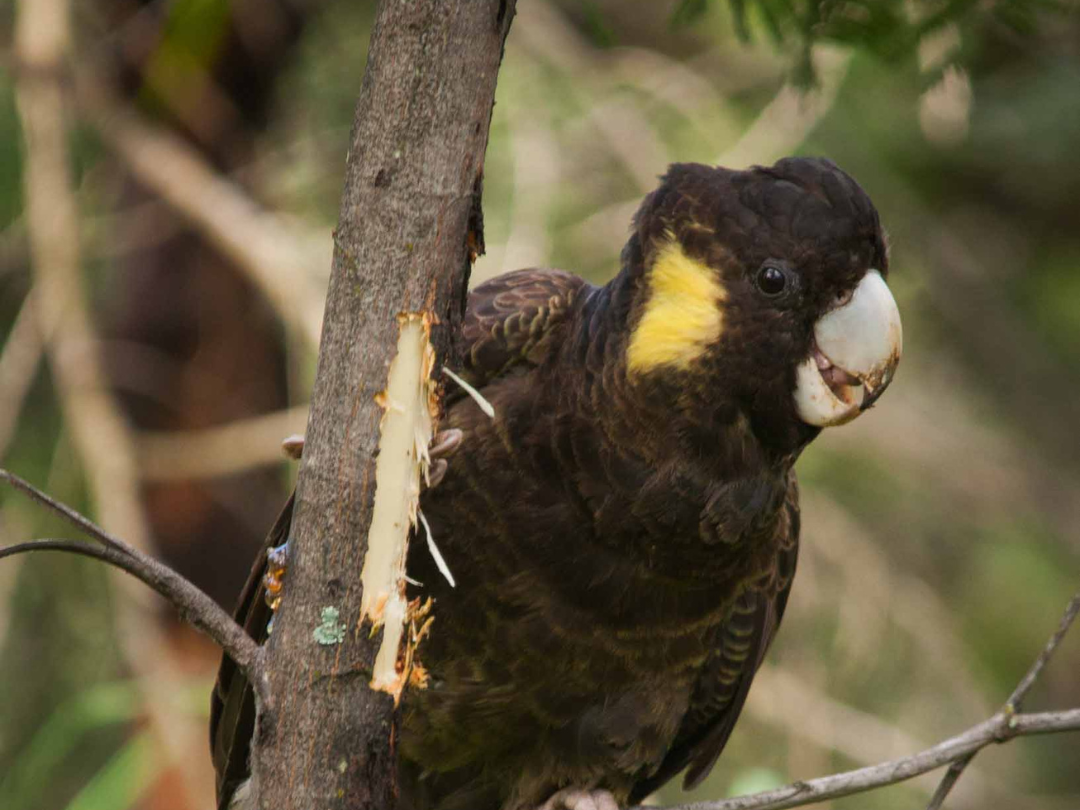
Words by Jen Willis, photo of a yellow tailed black cockatoo in a mature tree at Rosanna Parklands. (Banyule City Council website)